



Holmes, Harold D.
(1893-1959)
Honor Award Induction: 1966 Hall of Fame Induction: 1996 Harold Holmes was affectionately known as “Mr. Paddle of New Jersey” for his tireless efforts on behalf of the game in that state. A member of the Tremont Place Paddle Tennis Club in Orange, NJ, he also served as the APTA’s second President from 1938-1939.(Englewood Field Club, NJ).An outstanding player of the early game, Holmes created an upset in the second Men’s Nationals in 1936 when he and his partner, Richard G. Newell, defeated Fess Blanchard and Earle Gatchell at the Field Club in Greenwich, 3-6, 8-6, 4-6, 9-7, 15-13 (77 games and the longest on record) after holding 13 match points. To Blanchard’s great dismay, this would be the first—yet only—time in the first decade of Men’s Nationals that the winning team was not from Fox Meadow Tennis Club.
Harold was born in New Bedford, Massachusetts in 1893. His father, Charles Mason Holmes, owned and ran the Holmes textile mill in the city as part of the textile boom of the late 1800s through the 1920s. His parents belonged to the recently established Country Club of New Bedford, which boasted several new lawn tennis courts. It was there that Harold would first pick up a racquet and begin developing his elite talent in–and love for– racquet sports.
Harold won many local tennis tournament championships in his youth before attending Harvard (Class of 1916), where he was a student/athlete as part of a nationally recognized tennis team. By the time he was 21 in 1914, he was competing against the best players in the country. He qualified for and played in the Longwood Cricket Club tournament in Chestnut Hill, MA, an event that was part of the national professional circuit and preparation for the Davis Cup. Harold advanced to the fourth round, finally ousted by Thomas Bundy, a U.S. national doubles champion.
After college, he continued his elite level of play while working in the textile business with his dad as Assistant Superintendent at the Holmes Mill. He married Margaret Macfarlane in 1918, and by 1923 had a daughter, Margaret, and son, Charles. As the textile boom faded and moved south from New Bedford, he transplanted his family to Orange, New Jersey, commuting to New York City and continue in textiles, managing the conversion of raw material to finished product for sale to the thriving Garment District in New York City. The small Tremont Place Tennis Club was right around the corner from his home, so he could easily follow his passion after work and on weekends.
It was there in the early to mid-1930s that Harold helped establish the Tremont Place Paddle Tennis Club—one of only eight in the country. He leveraged all that lawn tennis experience and talent into his legacy as one of the most formidable platform tennis players of his time. (Tremont Place was home to the development of the first sand-textured court deck, which soon became the industry standard.)
In his later years as a grandfather, Harold loved kids and organized competitions such as sack races or bucket golf games (using tennis balls). He died suddenly at home in Orange in 1959, fittingly right after another long, joyful time on the court.
–Contributed by Stephen Cook, Harold Holmes’s grandson
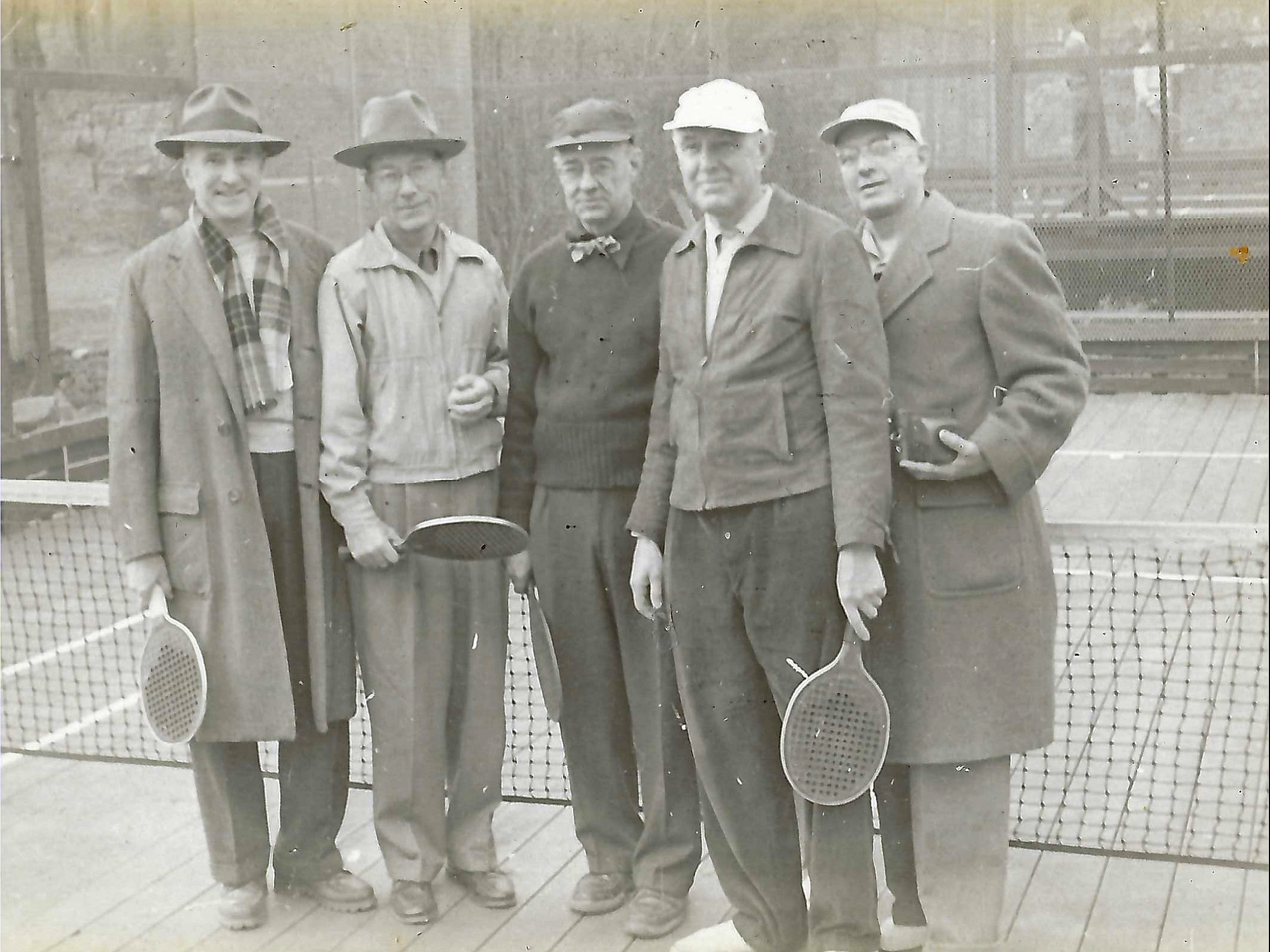 Harold (in front) with his Tremont Place crew.
 © 2026 Platform Tennis Museum and Hall of Fame Foundation, All Rights Reserved.